
Philippine enterprises are entering a critical phase of AI maturity where the architecture decisions made today will determine operational capability for the next five years. The shift from experimental AI pilots to production-grade multi-agent systems demands a rigorous architecture framework that addresses orchestration, governance, scalability, and compliance simultaneously.
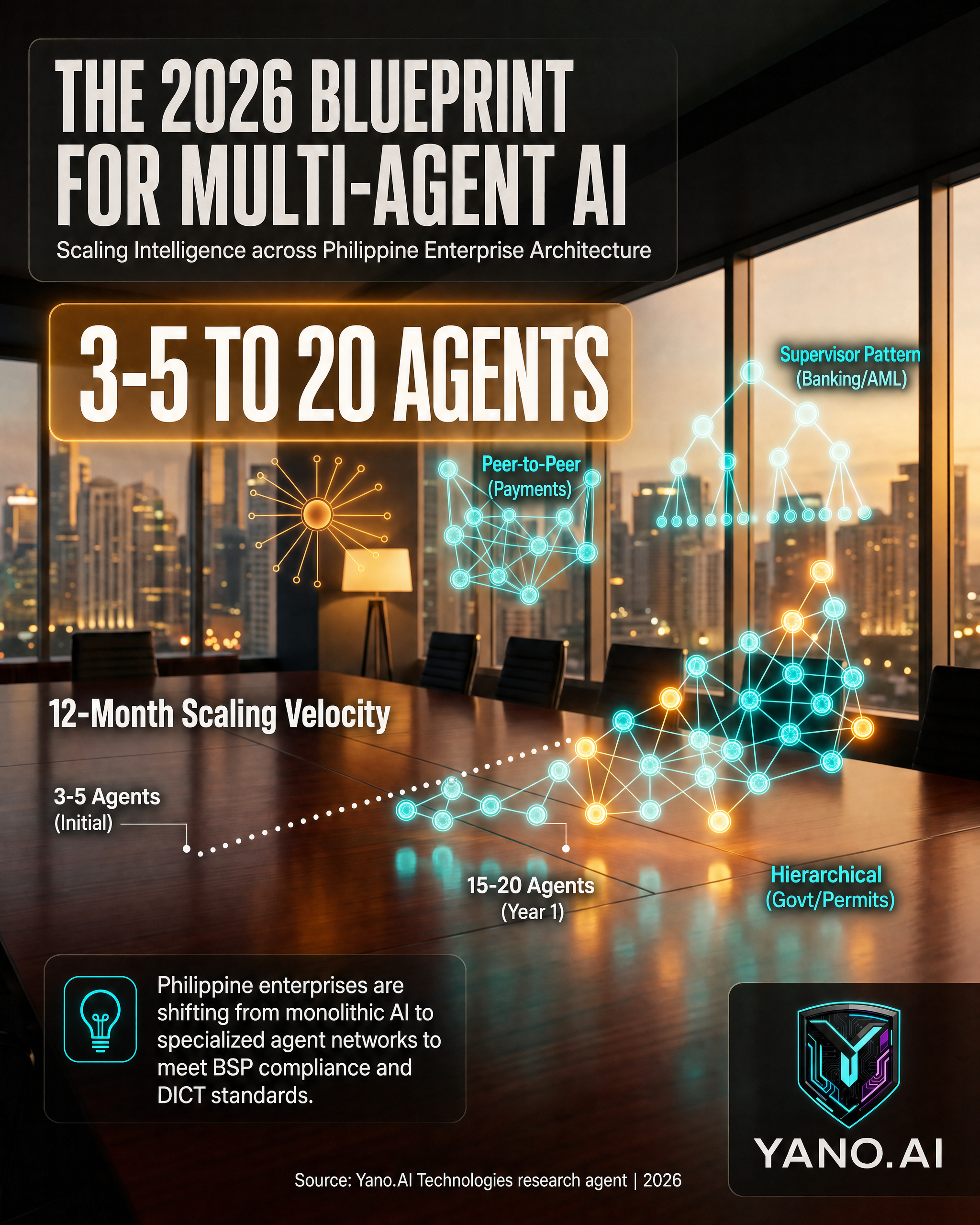
For Philippine banks, government agencies, and enterprise IT teams, this is not a theoretical exercise. BSP Memorandum No. M-2026-031 (July 2026) sets out voluntary AI governance principles for the financial sector, with supervisory expectations around explainability, auditability, and human oversight. DICT's Cloud First Policy requires sovereign infrastructure for government workloads. The National Privacy Commission demands explainable AI outputs for any system processing citizen data. These regulatory requirements converge on a single imperative: get the architecture right from day one.
The agentic AI stack that Philippine enterprises are converging on consists of four integrated layers: compute infrastructure for local inference, vector databases for knowledge retrieval, API gateways for policy enforcement, and governance systems for audit compliance. Each layer must be sovereign — operating within Philippine jurisdiction — while delivering the performance characteristics of global cloud AI services.
For Philippine banks implementing AI-powered fraud detection, the architecture must support real-time transaction analysis against behavioral patterns while maintaining complete audit trails for every decision. For government agencies deploying AI for citizen services, the architecture must ensure data never leaves Philippine borders while enabling the responsiveness that citizens expect from modern digital services.
The orchestration layer is where Philippine-specific requirements diverge most sharply from global patterns. Unlike US or EU deployments that can rely on hyperscaler AI services, Philippine enterprises must build sovereign orchestration layers that coordinate specialized AI agents through standardized protocols while maintaining decision logging aligned with BSP supervisory expectations. This requires purpose-built orchestration frameworks that understand Philippine regulatory contexts.
The Philippine enterprise AI market is projected to reach PHP 45 billion by 2028, driven primarily by banking, government, and telecommunications adoption. Organizations that invest in robust AI architecture foundations in 2026 will capture disproportionate value as the market matures — not because they have better models, but because they have better architecture.
FAQ
What architecture patterns support BSP AI governance expectations?
BSP Memorandum No. M-2026-031 is principles-based and does not prescribe or approve specific architectures. It expects institutions to maintain documentation, auditability, and traceability across the AI lifecycle under its Transparency and Accountability principles. Architectures that keep each decision traceable to a specific model version, input data, and inference context (such as a supervisor orchestration pattern) help institutions meet those expectations. Note that the guidance is voluntary, and BSP supervision runs to the institution, not to its vendors.
How does the DICT Cloud First Policy affect enterprise AI deployments?
DICT mandates that government data and AI workloads processing citizen information must operate on Philippine-sovereign infrastructure. This means self-hosted servers, Philippine-cloud providers, or hybrid architectures where inference happens locally and only anonymized metadata is shared externally.
What hardware is needed for production-grade sovereign AI?
For enterprise-grade multi-agent orchestration, a Kubernetes cluster with 3-5 GPU nodes (24-48GB VRAM each) can serve 15-20 specialized agents. The investment is comparable to traditional enterprise server infrastructure — approximately PHP 2-4 million for a production-ready setup.
How does multi-agent orchestration improve over single-model AI?
Single-model architectures route all tasks through one inference endpoint, creating bottlenecks and compliance risks. Multi-agent systems deploy specialized agents that handle specific domains independently, communicate through standardized APIs, and maintain separate audit trails — enabling parallel processing, better compliance, and easier debugging.
Key Takeaways
- Philippine regulatory requirements make architecture decisions in 2026 critical for long-term AI capability
- Sovereign AI architecture requires four integrated layers: compute, storage, networking, governance
- BSP, DICT, and NPC regulations converge on auditable, explainable, and resident AI infrastructure
- Philippine enterprises should invest in architecture foundations now rather than optimizing individual AI models
- The orchestration layer is the key differentiator for Philippine-specific enterprise AI deployments
Sources
BSP Memorandum No. M-2026-031 — Governance Principles for Artificial Intelligence in Financial Services (July 2026) DICT Cloud First Policy — Government AI Infrastructure (2025) National Privacy Commission — AI and Data Privacy Guidelines (2025) Philippine Enterprise AI Market Report (2026)
Sources — external references open in a new tab.